
Identity area
Reference code
Title
Date(s)
- 1931-1952 (1939-1948) (Creation)
Level of description
Extent and medium
129 metal boxes. Paper holder.
Context area
Name of creator
Administrative history
The Ministry of Foreign Affairs was established by Article 84 of the National Constitution of May 1, 1853, making it one of the first five ministries in Argentina. Law 80 of 1856, in its second article, defined its responsibilities as follows: maintaining the Confederation’s political and commercial relations with foreign nations; fostering friendly relations and good understanding with foreign governments; and receiving diplomatic ministers, consuls, and other commercial agents. It was also tasked with matters concerning the drafting, observance, interpretation, and execution of all types of treaties, concordats, or other agreements with foreign powers. Furthermore, the Ministry was responsible for publishing declarations of war or other official statements intended for foreign audiences; appointing diplomatic, consular, or commercial agents abroad—as well as all individuals serving in the realm of Argentine foreign relations—and issuing their instructions. Finally, it was charged with addressing territorial issues between the Confederation and neighboring nations, ensuring the observance of the guarantees and rights granted to foreigners under the Constitution, and managing correspondence with national and provincial authorities regarding foreign affairs. In October 1898, Law No. 3727 added the area of "Worship" (religious affairs) to the Ministry’s mandate, leading to its renaming as the "Ministry of Foreign Affairs and Worship." The functions of this new area involved maintaining the link between the State and the Roman Catholic Church—encompassing concordats, the patronato (state patronage) regarding the establishment of bishoprics, and all matters concerning ecclesiastical chapters, religious orders, and seminaries. It also covered religious missions among Indigenous populations, as well as all matters related to pious institutions, public charitable or benevolent organizations, and subsidies for churches, hospitals, orphanages, and various charitable or religious societies and corporations. The decree for the reorganization of the Ministry, dated December 29, 1900, established a section for "Private Affairs, Charity, and Religious Worship," which was tasked with the following: correspondence with authorities of the Catholic Church and other religious denominations, as well as matters pertaining to charity; the negotiation of concordats; issues regarding state patronage and the establishment of bishoprics; matters concerning ecclesiastical chapters, religious orders, and seminaries; religious missions among Indigenous populations; all affairs related to pious institutions and public charitable or benevolent organizations, including subsidies for churches, hospitals, orphanages, and charitable or religious societies or corporations; and the National Charity Lottery. Between 1947 and 1948, documentation concerning hospital and social assistance services was transferred to the Secretariat of Public Health, as these matters fell under its jurisdiction. Nevertheless, the core functions of the Foreign Ministry have endured over time, even as its internal structure has diversified and its network of overseas missions has expanded significantly. Through Law No. Under Law No. 24,190, published on January 13, 1993, the ministry assumed responsibility for economic and trade affairs within its jurisdiction, and its name was changed to “Ministry of Foreign Affairs, International Trade and Worship.” In 2000, the “White Helmets” Commission—the successor body to the White Helmets Secretariat for International Humanitarian Assistance—was placed under its purview. On December 7, 2011, via Decree 2082/2011, the administration of Cristina Fernández de Kirchner transferred the management of international trade to the Ministry of Economy and Public Finance, and the ministry reverted to its former name: “Ministry of Foreign Affairs and Worship.” In 2019, through Emergency Decree (DNU) No. 7/2019, President Alberto Fernández restored the name “Ministry of Foreign Affairs, International Trade and Worship.”
Archival history
To date, we have not found significant information regarding the archival history; we can only note that the 1978 Annual Report of the Ministry of Foreign Affairs and Worship mentions—among the tasks carried out by the Archive—the replacement of storage boxes and the creation of labels for what was then designated as the "Second World War" series. Among the finding aids produced by the Archive Directorate, there is a descriptive tool for this subsection, created by the department, though its date of origin is unknown. As part of the identification and description work conducted under the "Archive Project" (see the Archive’s history in the MREC Archive’s ISDIAH standard), the subsection underwent a re-description at the level of individual preservation units in mid-2009; subsequently, in 2012, an initial ISAD(G)-compliant description was prepared for the subsection. In 2019, the National Foreign Service Institute (ISEN) returned three files belonging to this documentary group to the Archive; these were incorporated into the records under the identifiers AH/0087/14, AH/0088/15, and AH/0122/32.
Immediate source of acquisition or transfer
Transfer
Content and structure area
Scope and content
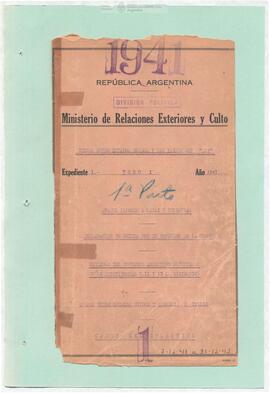
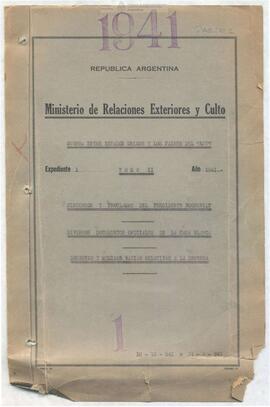
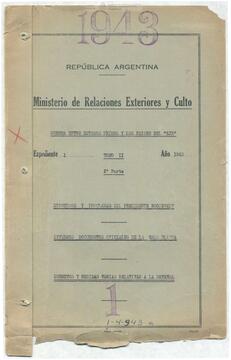
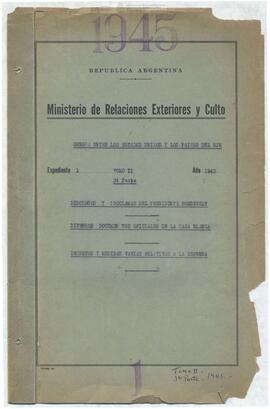
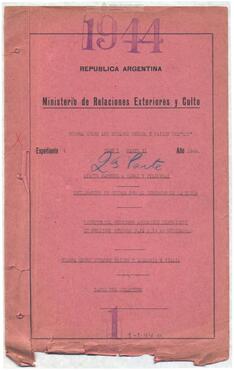
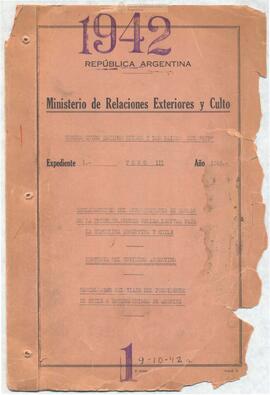
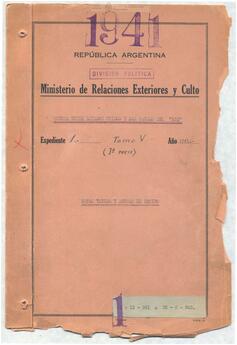
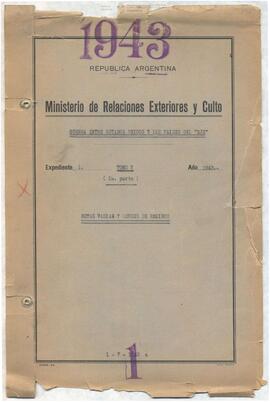
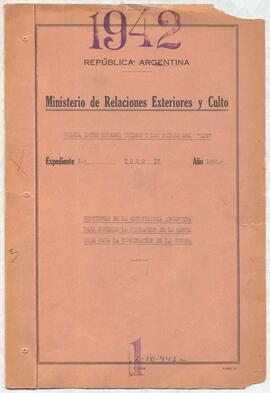
Given the broad scope and general nature of the functions assigned to the Political Division regarding the war, the matters arising from its operations were vast and complex. This subsection was tasked with centralizing and distributing all information pertaining to war-related issues, as well as issuing instructions to be followed regarding foreign policy. In this capacity, it served as a hub for communications to and from Argentina’s diplomatic missions abroad, foreign diplomatic missions within Argentina, the relevant departments of the Ministry of Foreign Affairs—those with jurisdiction over matters stemming from Argentina’s status as a neutral or belligerent nation—and other ministries within the National Executive branch. Examples of these functions include: - Neutrality of various countries: Argentina’s diplomatic missions abroad were required to forward to the Political Division any information concerning the stance of their host countries regarding the war. These files, labeled “Neutrality of…,” document the evolution of a given country’s policy from the beginning to the end of the war, including some of the debates that arose. The files may contain decrees, resolutions, newspaper articles, telegrams, speeches, and other types of documents sent by our representatives. - Argentina’s stance: The Political Division was responsible for communicating to the relevant internal departments of the Ministry of Foreign Affairs, other national ministries, and diplomatic missions abroad all measures deemed necessary in light of the state of war. Consequently, it disseminated the Executive branch’s decisions on the matter and provided guidance on the practical implications of these directives. - Representing Argentine policy abroad: The Political Division communicated to foreign diplomatic missions in Argentina the measures adopted by the Executive branch regarding the state of war. - Handling of the interests of a foreign country within belligerent states: such requests were made whenever a state declared war and asked another state to look after its interests within the territory of the former. - Reports regarding declarations of war by foreign countries - Peace initiatives undertaken by Argentina - Reports on international meetings (Third Meeting of Ministers of Foreign Affairs in Rio de Janeiro, the Quebec Conference, the Havana Meeting) - Reports on military operations during the war - Complaints from foreign states regarding the activities of spies in Argentina - Communications between Ministers of Foreign Affairs - Commentary from the foreign press concerning Argentina - Assistance to Argentine citizens residing in countries involved in the conflict - Regulations from foreign countries related to the conflict - Requests from companies based in Argentina to be removed from "blacklists." - Administration of the former crew members of the Graf Spee - Internment records for former Graf Spee crew members: official forms or registration documents bearing the letterhead of the "Ministry of the Interior – Federal Capital Police," which include a photograph of the former crew member and their personal details. In some instances, these records also note transfers, escapes, arrests, marriages, etc. - Reports concerning the Graf Spee and its crew members. These are some examples of the administrative procedures handled by the unit within the Political Division that has been identified as the "Second World War" subsection.
Appraisal, destruction and scheduling
The process of appraisal, selection, and disposal prior to accession into the AHMRE is unknown.
Accruals
System of arrangement
Conditions of access and use area
Conditions governing access
No restrictions. Access to the original documentation is restricted for preservation purposes. Access to digital copies may be requested by contacting the AHMRE via its institutional email address (archivo@mrecic.gob.ar). Consultation is subject to the Archive’s User Regulations, available at: https://www.cancilleria.gob.ar/es/institucional/patrimonio/archivo-historico-de-cancilleria/atencion-usuarios/reglamento
Conditions governing reproduction
Reproduction conditions: No legal restrictions. In all cases, the AHMRE user agrees to cite the source, in accordance with Article 11 of the Archive’s User Regulations.
Language of material
Spanish
Script of material
Latin
Language and script notes
Spanish (ES) – Script: Latin (Latn) in the majority of documents, although numerous documents in English (EN), Italian (IT), German (DE), French (FR), etc., are also found.
The translation of the records for the Fonds, Section, and Subsection levels has been carried out using the Google Translate application.
Physical characteristics and technical requirements
The documentation has a digital copy; therefore, it is excluded from public access to prevent further deterioration caused by physical handling. A device (such as a computer, tablet, etc.) is required to view the digital copies.
Finding aids
Analytical Inventory (available at: https://www.cancilleria.gob.ar/es/institucional/patrimonio/archivo-historico-de-cancilleria/atencion-usuarios/guia-de-fondos/44)
Allied materials area
Existence and location of originals
It is not applicable.
Existence and location of copies
It is not applicable.
Related units of description
Within the documentary collection of the Ministry of Foreign Affairs, International Trade and Worship, we find the following groupings related to this subsection: - Political Division Section - AR AHMRE 35 - Sub-fonds: Board for the Surveillance and Final Disposition of Enemy Property - AR AHMRE 46 - Argentine Embassy in France Section - AR AHMRE 15 - Administrative Litigation Directorate - AR AHMRE 40 - Migration, Colonization, and Tourism - AR AHMRE 113 - Consulate in Berlin - AR AHMRE 117 - Embassy in Sweden - AR AHMRE 112
Publication note
Assali, L. and A. Lombardi, “La política exterior argentina desde adentro. El funcionamiento de la Cancillería durante la Segunda Guerra Mundial: una mirada desde el archivo “ in Historia y Guerra, Buenos Aires, Instituto Ravignani, January–June 2024, No. 5.
Notes area
Alternative identifier(s)
Access points
Subject access points
Place access points
Name access points
Genre access points
Description control area
Description identifier
Institution identifier
Rules and/or conventions used
Status
Level of detail
Dates of creation revision deletion
Language(s)
Script(s)
Sources
Archivist's note
Description revised by Alba Lombardi Description created by Laura Assali