
Identity area
Reference code
Title
Date(s)
- 1810 (Creation)
Level of description
Extent and medium
7,000 linear meters. Paper.
Context area
Name of creator
Administrative history
The Ministry of Foreign Affairs was established by Article 84 of the National Constitution of May 1, 1853, making it one of the first five ministries in Argentina. Law 80 of 1856, in its second article, defined its responsibilities as follows: maintaining the Confederation’s political and commercial relations with foreign nations; fostering friendly relations and good understanding with foreign governments; and receiving diplomatic ministers, consuls, and other commercial agents. It was also tasked with matters concerning the drafting, observance, interpretation, and execution of all types of treaties, concordats, or other agreements with foreign powers. Furthermore, the Ministry was responsible for publishing declarations of war or other official statements intended for foreign audiences; appointing diplomatic, consular, or commercial agents abroad—as well as all individuals serving in the realm of Argentine foreign relations—and issuing their instructions. Finally, it was charged with addressing territorial issues between the Confederation and neighboring nations, ensuring the observance of the guarantees and rights granted to foreigners under the Constitution, and managing correspondence with national and provincial authorities regarding foreign affairs. In October 1898, Law No. 3727 added the area of "Worship" (religious affairs) to the Ministry’s mandate, leading to its renaming as the "Ministry of Foreign Affairs and Worship." The functions of this new area involved maintaining the link between the State and the Roman Catholic Church—encompassing concordats, the patronato (state patronage) regarding the establishment of bishoprics, and all matters concerning ecclesiastical chapters, religious orders, and seminaries. It also covered religious missions among Indigenous populations, as well as all matters related to pious institutions, public charitable or benevolent organizations, and subsidies for churches, hospitals, orphanages, and various charitable or religious societies and corporations. The decree for the reorganization of the Ministry, dated December 29, 1900, established a section for "Private Affairs, Charity, and Religious Worship," which was tasked with the following: correspondence with authorities of the Catholic Church and other religious denominations, as well as matters pertaining to charity; the negotiation of concordats; issues regarding state patronage and the establishment of bishoprics; matters concerning ecclesiastical chapters, religious orders, and seminaries; religious missions among Indigenous populations; all affairs related to pious institutions and public charitable or benevolent organizations, including subsidies for churches, hospitals, orphanages, and charitable or religious societies or corporations; and the National Charity Lottery. Between 1947 and 1948, documentation concerning hospital and social assistance services was transferred to the Secretariat of Public Health, as these matters fell under its jurisdiction. Nevertheless, the core functions of the Foreign Ministry have endured over time, even as its internal structure has diversified and its network of overseas missions has expanded significantly. Through Law No. Under Law No. 24,190, published on January 13, 1993, the ministry assumed responsibility for economic and trade affairs within its jurisdiction, and its name was changed to “Ministry of Foreign Affairs, International Trade and Worship.” In 2000, the “White Helmets” Commission—the successor body to the White Helmets Secretariat for International Humanitarian Assistance—was placed under its purview. On December 7, 2011, via Decree 2082/2011, the administration of Cristina Fernández de Kirchner transferred the management of international trade to the Ministry of Economy and Public Finance, and the ministry reverted to its former name: “Ministry of Foreign Affairs and Worship.” In 2019, through Emergency Decree (DNU) No. 7/2019, President Alberto Fernández restored the name “Ministry of Foreign Affairs, International Trade and Worship.”
Archival history
The Ministry of Foreign Affairs was established by Article 84 of the National Constitution of May 1, 1853, making it one of the first five ministries in Argentina. Law 80 of 1856, in its second article, defined its responsibilities as follows: maintaining the Confederation’s political and commercial relations with foreign nations; fostering friendly relations and good understanding with foreign governments; and receiving diplomatic ministers, consuls, and other commercial agents. It was also tasked with matters concerning the drafting, observance, interpretation, and execution of all types of treaties, concordats, or other agreements with foreign powers. Furthermore, the Ministry was responsible for publishing declarations of war or other official statements intended for foreign audiences; appointing diplomatic, consular, or commercial agents abroad—as well as all individuals serving in the realm of Argentine foreign relations—and issuing their instructions. Finally, it was charged with addressing territorial issues between the Confederation and neighboring nations, ensuring the observance of the guarantees and rights granted to foreigners under the Constitution, and managing correspondence with national and provincial authorities regarding foreign affairs. In October 1898, Law No. 3727 (dated October 10, 1898) added the area of "Culto" (religious affairs) to the Ministry’s mandate, resulting in a name change to the "Ministry of Foreign Affairs and Religious Affairs." The functions of this new "Worship" (Culto) division involved maintaining the link between the State and the Roman Catholic Church. This included managing concordats, the patronato (state patronage) regarding the establishment of bishoprics, matters concerning ecclesiastical chapters, religious orders, and seminaries, as well as religious missions among Indigenous populations. It also encompassed oversight of pious, charitable, or public welfare institutions, the provision of subsidies to churches, hospitals, orphanages, and various charitable or religious societies and corporations. The Ministry’s reorganization decree of December 29, 1900, established a section for "Private Affairs, Charity, and Worship," which was tasked with the following: correspondence with authorities of the Catholic Church and other religious denominations, as well as matters related to charity; the negotiation of concordats; patronato affairs, the establishment of bishoprics, and matters concerning ecclesiastical chapters, religious orders, and seminaries; religious missions among Indigenous populations; oversight of pious, charitable, or public welfare institutions, subsidies for churches, hospitals, orphanages, and charitable or religious societies or corporations; and the National Charity Lottery. Between 1947 and 1948, documentation related to hospital and social assistance services was transferred to the Secretariat of Public Health, as these matters fell under its jurisdiction. Nevertheless, the core functions of the Foreign Ministry (Cancillería) have endured over time, even as its internal structure has diversified and its network of overseas missions has expanded significantly. Through Law No. Under Law No. 24,190, published on January 13, 1993, the ministry assumed responsibility for economic and trade affairs within its jurisdiction, and its name was changed to “Ministry of Foreign Affairs, International Trade and Worship.” In 2000, the “White Helmets” Commission—the successor body to the White Helmets Secretariat for International Humanitarian Assistance—was placed under its purview. On December 7, 2011, via Decree 2082/2011, the administration of Cristina Fernández de Kirchner transferred the management of international trade to the Ministry of Economy and Public Finance, and the ministry reverted to its former name: “Ministry of Foreign Affairs and Worship.” In 2019, through Emergency Decree (DNU) No. 7/2019, President Alberto Fernández restored the name “Ministry of Foreign Affairs, International Trade and Worship.”
Immediate source of acquisition or transfer
Transfer
Content and structure area
Scope and content
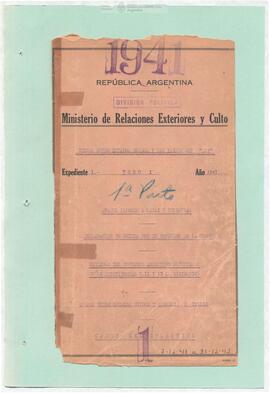
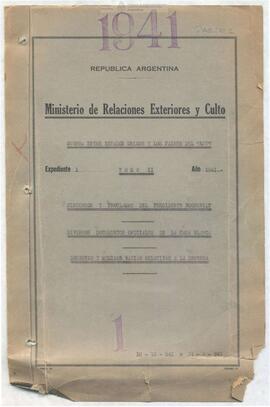
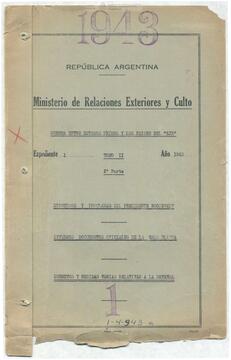
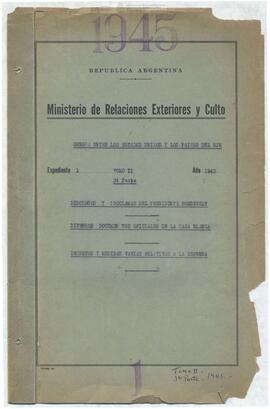
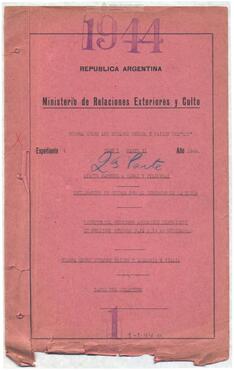
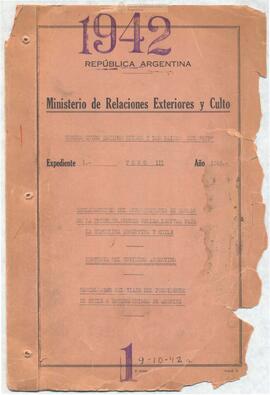
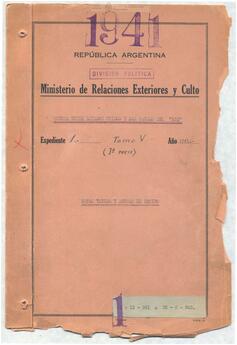
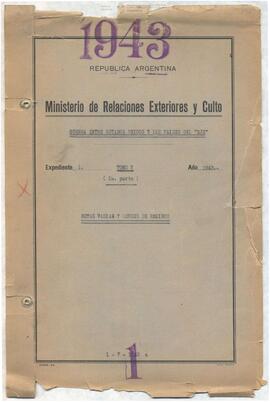
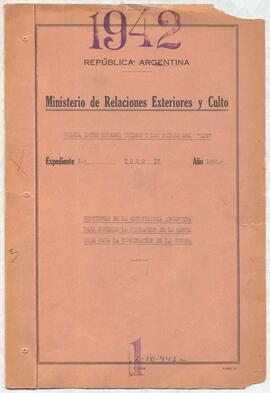
The collection contains documentation generated by the Argentine Ministry of Foreign Affairs, International Trade and Worship in the fulfillment of its missions and functions; specifically, it includes records pertaining to the political, economic, cultural, and migratory relations—as well as matters related to religious affairs—between the Argentine Republic and other sovereign states and international organizations. It also includes documentation concerning the operations and personnel administration of the Ministry and its diplomatic and consular missions abroad.
Appraisal, destruction and scheduling
While we do not have an exhaustive account of the destruction of records that took place within the Ministry of Foreign Affairs, International Trade and Worship, we have identified correspondence sent by Argentine diplomatic missions abroad—dating from before the enactment of national regulations on the selection of records (Decree 1571/1981)—in which authorization was requested to dispose of specific series or selections of official documents.
Accruals
System of arrangement
Conditions of access and use area
Conditions governing access
Access to the collection’s documentation is governed by the Regulations for the Archive of the Ministry of Foreign Affairs, International Trade and Worship, approved by Ministerial Resolution No. 243 of 2018, available at: https://www.cancilleria.gob.ar/es/institucional/patrimonio/archivo-historico-de-cancilleria/atencion-usuarios/reglamento
Conditions governing reproduction
Whenever documentation has been digitized, access will be provided to the digital copy rather than the original, in order to help preserve the materials and prevent any damage that might result from handling them. In cases where the original material is consulted, users are permitted to take photographs of the documents, provided that no flash is used; such photographs may only be taken at the table assigned to the user within the Reading Room, and under no circumstances should files or folders be forced open. In all cases, users agree to cite the source of the materials.
Language of material
Spanish
Script of material
Language and script notes
Most of the documents are in:
Language: Spanish
Script: Latin
However, there is a smaller proportion of materials in other languages.
The translation of the records for the Fonds, Section, and Subsection levels has been carried out using the Google Translate application.
Physical characteristics and technical requirements
There are no technical requirements for accessing documentation in its original format. For digitized documentation, a device capable of displaying digital objects (such as a computer, tablet, or mobile phone) is required.
Finding aids
Classification Scheme (available at: https://www.cancilleria.gob.ar/es/institucional/patrimonio/archivo-historico-de-cancilleria/atencion-usuarios/cuadro-de-clasificacion) Guide to Documentary Groups (available at: https://www.cancilleria.gob.ar/es/institucional/patrimonio/archivo-historico-de-cancilleria/atencion-usuarios/guia-de-fondos) Inventories (available at: https://www.cancilleria.gob.ar/es/institucional/patrimonio/archivo-historico-de-cancilleria/atencion-usuarios/inventarios)
Allied materials area
Existence and location of originals
Existence and location of copies
Not applicable
Related units of description
No information
Publication note
Assali, L. and Lombardi, A., "La administración de la propiedad enemiga. Alcances de la documentación del Archivo de la Cancillería Argentina" (2019) Assali, L. y Lombardi, A., "Gobernar también es archivar: la conformación del Archivo del Ministerio de Relaciones Exteriores en el período 1862-1900" (2017) Assali, L. y Lombardi, A., "Alcances y problemáticas de la documentación de archivo para la investigación de la historia recienta. Estudio de caso sobre el Archivo de Cancillería" (2015).
Notes area
Note
Not applicable
Alternative identifier(s)
Access points
Subject access points
Place access points
Name access points
Genre access points
Description control area
Description identifier
Institution identifier
Rules and/or conventions used
Status
Level of detail
Dates of creation revision deletion
Language(s)
Script(s)
Sources
Archivist's note
Alba Lombardi, Laura Assali