
Identity area
Reference code
Title
Date(s)
- 1931 (Creation)
Level of description
Extent and medium
This information has not been provided for the purposes of this project.
Context area
Name of creator
Administrative history
The Ministry of Foreign Affairs was established by Article 84 of the National Constitution of May 1, 1853, making it one of the first five ministries in Argentina. Law 80 of 1856, in its second article, defined its responsibilities as follows: maintaining the Confederation’s political and commercial relations with foreign nations; fostering friendly relations and good understanding with foreign governments; and receiving diplomatic ministers, consuls, and other commercial agents. It was also tasked with matters concerning the drafting, observance, interpretation, and execution of all types of treaties, concordats, or other agreements with foreign powers. Furthermore, the Ministry was responsible for publishing declarations of war or other official statements intended for foreign audiences; appointing diplomatic, consular, or commercial agents abroad—as well as all individuals serving in the realm of Argentine foreign relations—and issuing their instructions. Finally, it was charged with addressing territorial issues between the Confederation and neighboring nations, ensuring the observance of the guarantees and rights granted to foreigners under the Constitution, and managing correspondence with national and provincial authorities regarding foreign affairs. In October 1898, Law No. 3727 added the area of "Worship" (religious affairs) to the Ministry’s mandate, leading to its renaming as the "Ministry of Foreign Affairs and Worship." The functions of this new area involved maintaining the link between the State and the Roman Catholic Church—encompassing concordats, the patronato (state patronage) regarding the establishment of bishoprics, and all matters concerning ecclesiastical chapters, religious orders, and seminaries. It also covered religious missions among Indigenous populations, as well as all matters related to pious institutions, public charitable or benevolent organizations, and subsidies for churches, hospitals, orphanages, and various charitable or religious societies and corporations. The decree for the reorganization of the Ministry, dated December 29, 1900, established a section for "Private Affairs, Charity, and Religious Worship," which was tasked with the following: correspondence with authorities of the Catholic Church and other religious denominations, as well as matters pertaining to charity; the negotiation of concordats; issues regarding state patronage and the establishment of bishoprics; matters concerning ecclesiastical chapters, religious orders, and seminaries; religious missions among Indigenous populations; all affairs related to pious institutions and public charitable or benevolent organizations, including subsidies for churches, hospitals, orphanages, and charitable or religious societies or corporations; and the National Charity Lottery. Between 1947 and 1948, documentation concerning hospital and social assistance services was transferred to the Secretariat of Public Health, as these matters fell under its jurisdiction. Nevertheless, the core functions of the Foreign Ministry have endured over time, even as its internal structure has diversified and its network of overseas missions has expanded significantly. Through Law No. Under Law No. 24,190, published on January 13, 1993, the ministry assumed responsibility for economic and trade affairs within its jurisdiction, and its name was changed to “Ministry of Foreign Affairs, International Trade and Worship.” In 2000, the “White Helmets” Commission—the successor body to the White Helmets Secretariat for International Humanitarian Assistance—was placed under its purview. On December 7, 2011, via Decree 2082/2011, the administration of Cristina Fernández de Kirchner transferred the management of international trade to the Ministry of Economy and Public Finance, and the ministry reverted to its former name: “Ministry of Foreign Affairs and Worship.” In 2019, through Emergency Decree (DNU) No. 7/2019, President Alberto Fernández restored the name “Ministry of Foreign Affairs, International Trade and Worship.”
Archival history
The MREC (Ministry of Foreign Affairs and Worship) annual reports for the periods 1923–1925, 1925, 1926, 1937–1938, and 1939–1940 document the transfer of boxes and files from the Political Division to the Archive. The 1980 MREC annual report notes that the boxes for the “documentary series” (sic) known as the Political Division were replaced and relabeled. When the MREC documentary collection was relocated in 2007 as part of the “Archive Project”—mandated by Resolution 453/2006—the boxes from this section arrived largely grouped according to their provenance. In many instances, errors in this initial identification were subsequently discovered and corrected. Furthermore, between 2008 and 2009, efforts were made to restore the original order of various folders, files, and boxes that had been misplaced. Based on the original arrangement of the documentary material, an inventory was compiled by preservation unit. Where analytical inventories—created by previous administrations and covering primarily the years 1933–1951—were found, they were cross-referenced with the preserved records and digitized. Between 2018 and 2019, 35 boxes from this section were digitized as part of an agreement between the MREC Archive and the United States Holocaust Memorial Museum. Finally, in 2022, the collection was made available for public consultation, following the completion of necessary quality control checks and the creation of access copies.
Immediate source of acquisition or transfer
Transfer
Content and structure area
Scope and content
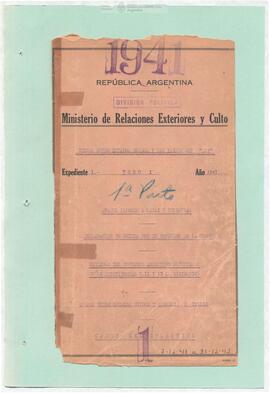
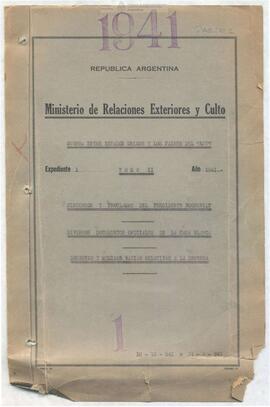
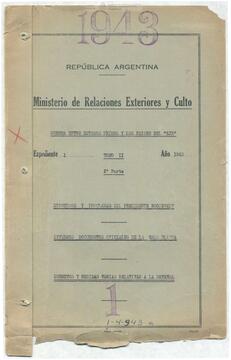
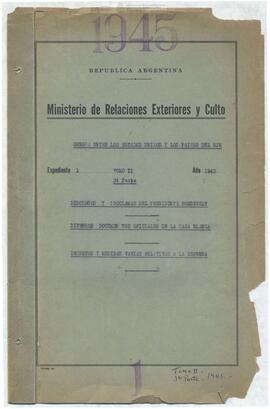
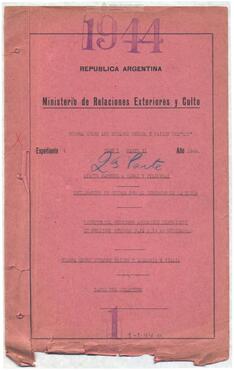
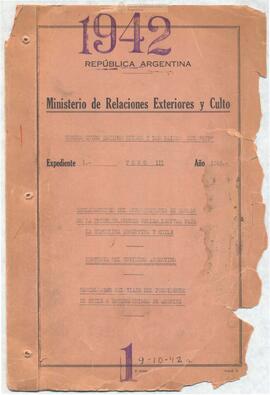
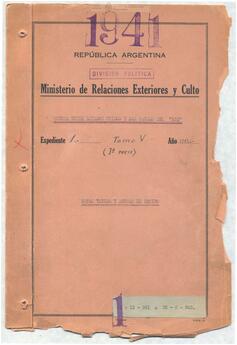
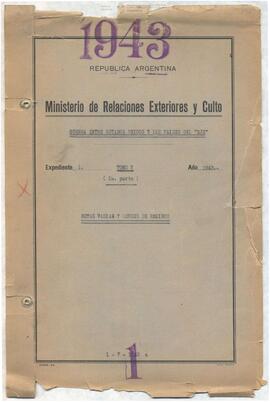
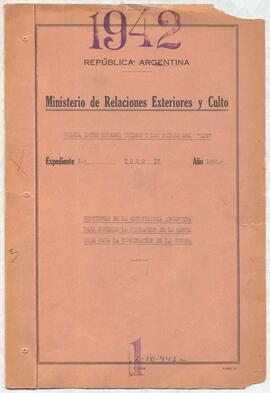
Within this section, one primarily finds correspondence—organized by country—that was regularly exchanged between Argentine diplomatic and consular missions and the Argentine Ministry of Foreign Affairs and Worship, specifically its Political Division. In addition to the country and year, most folder covers include a brief description of their contents. Certain categories appear frequently, such as “Domestic Policy,” “Foreign Policy,” “Annual Report,” “Laws and Decrees,” “Miscellaneous Matters,” “Press/Newspaper Clippings,” “Presentation of Credentials,” “Requests for Authorization to Fly Flags,” “Informational Reports,” etc. Other categories are linked to specific events regarding which information was being provided or instructions were being requested. Furthermore, this section contains several distinct, smaller groupings, including: ● Armaments (1910–1948): this category includes reports on the purchase of armaments and naval vessels by Argentina and other countries (notably Chile); newspaper clippings concerning armament acquisitions; and financial statements/accountings related to such acquisitions. ● Bolivia – Paraguay (1932–1939) This documentation primarily concerns the conflict between Bolivia and Paraguay between 1932 and 1935: - Reports on the Chaco Conflict, including mediation by Argentina and the League of Nations - Newspaper clippings - Correspondence from the Head of the War Secretariat containing information about the conflict - Reports on issues in the Chaco Boreal in relation to the situation of the countries involved - Actions taken by Argentina following its declaration of neutrality in the Chaco Conflict - Observations from the belligerent governments regarding solutions proposed by the League of Nations Assembly - Correspondence between the Ministry and the War Secretariat ● Miscellaneous: This category contains documentation that does not pertain to relations with a specific country. It includes requests submitted to the Political Division by national and provincial Argentine courts seeking information on international matters; requests from private individuals for the issuance of certificates; actions related to nominations for the Nobel Peace Prize; reports on visits by prominent figures to the country; and other general topics related to the functions of this organizational unit. Finally, there are non-serial, sporadic records concerning specific subjects, such as presidential visits, communications with national and provincial authorities, information regarding border incidents, international policy, etc. 3.2 Appraisal, selection, and disposal: The process of appraisal, selection, and disposal prior to the records' accession into the AHMRE is unknown. 3.3 New accessions: This is a closed section with no pending documentation to be added. 3.4 Organization: This section was organized—likely by the office that created the records—into folders, each labeled on its cover with the name of the department, the country to which the documentation pertains, the year, and the subject matter.
Appraisal, destruction and scheduling
Accruals
System of arrangement
Conditions of access and use area
Conditions governing access
No restrictions. The documentation is open to the public. It may be consulted in paper format by scheduling an appointment via email at archivo@mrecic.gob.ar. Access to the original documents contained in digitized boxes is restricted for preservation purposes. Access to digital copies may be obtained by submitting a request to the AHMRE’s official email address. Consultation is subject to the Archive’s User Regulations, available at: https://www.cancilleria.gob.ar/es/institucional/patrimonio/archivo-historico-de-cancilleria/atencion-usuarios/reglamento
Conditions governing reproduction
Provided that their condition allows for it and the structure of the materials is respected, photographs of the documents may be taken without the use of a flash.
Language of material
Spanish
Script of material
Latin
Language and script notes
Most of the documents are in:
Language: Spanish
Script: Latin
However, there is a smaller proportion of materials in other languages.
The translation of the records for the Fonds, Section, and Subsection levels has been carried out using the Google Translate application.
Physical characteristics and technical requirements
The documents within each file are physically fastened together in various ways (stitching, plastic clips, etc.), and users must maintain this structure when consulting them. For conservation purposes and to ensure the integrity of the collection, these fasteners must not be removed. Documents for which a digital copy exists are excluded from public access to prevent further deterioration caused by physical handling. In such cases, a device (such as a computer or tablet) is required to view the digital copies.
Finding aids
Inventory by preservation unit (for the entire section) – Analytical inventory (for the boxes that have been digitized)
Allied materials area
Existence and location of originals
Not applicable
Existence and location of copies
35 (thirty-five) boxes from the section were digitized by the MREC Archive and are available for public consultation.
Related units of description
Within the documentary collection of the Ministry of Foreign Affairs, International Trade and Worship, we find the following groupings related to this Section: Commercial Division Section - AR AHMRE 36; Administrative Division Section - AR AHMRE 20; Undersecretariat Office Section - AR AHMRE 54; Treaties and Conferences Section - AR AHMRE 8; Embassy in Spain Section - AR AHMRE 23 A - 23 B; Embassy in France Section - AR AHMRE 15; Embassy in Peru Section - AR AHMRE 22 A - 22 B; Embassy in Paraguay Section - AR AHMRE 19 A; Embassy in Uruguay Section - AR AHMRE 11; Embassy in the United States Section - AR AHMRE 27 A; Embassy in Sweden Section - AR AHMRE 112; Embassy in South Africa Section - AR AHMRE 31; Legation in Colombia and Venezuela Section - AR AHMRE 84; Embassy in Israel Section - AR AHMRE 91; Embassy in the Federal Republic of Germany Section - AR AHMRE 61; Second World War Subsection - AR AHMRE 44; Spanish Civil War Subsection - AR AHMRE 42.
Publication note
Assali, L. and A. Lombardi, “La política exterior argentina desde adentro. El funcionamiento de la Cancillería durante la Segunda Guerra Mundial: una mirada desde el archivo “ en Historia y Guerra, Buenos Aires, Instituto Ravignani, January–June 2024, No. 5.
Notes area
Note
Despite changes in the section’s designation throughout its institutional history, the decision has been made to retain the name "Political Division"—the term by which the area was known for the longest period, and the designation used consistently across the various administrations of the MREC Archive.
Alternative identifier(s)
Access points
Subject access points
Place access points
Name access points
Genre access points
Description control area
Description identifier
Institution identifier
Rules and/or conventions used
Status
Level of detail
Dates of creation revision deletion
2026 - Creation
Language(s)
Script(s)
Sources
Archivist's note
Description created by: Alba Lombardi